
Log Classification System Using Deepseek R1 LLM, NLP, Regex, BERT
Date:
Code: github.com/qzaman243/Hybrid-Log-Classification-System-Using-Deepseek-R1-LLM-NLP-Regex-BERT
How it works
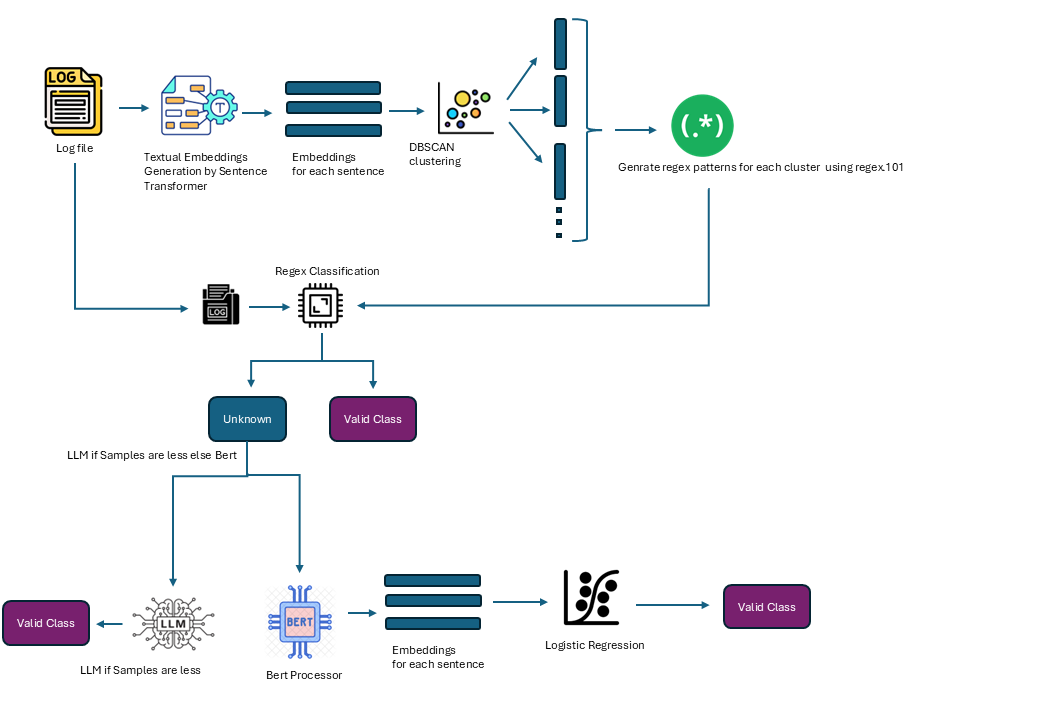
- Learning regex rules from the data. Each log line is turned into an embedding with a Sentence Transformer. DBSCAN groups similar logs into clusters, and a regex pattern is written for each cluster (with the help of regex101).
- Regex classification. New logs are first matched against these patterns. This fast, free step handles the most common, well-structured logs and assigns them a valid class right away.
- Handling unknown logs. Logs that no pattern matches are marked Unknown and sent to a model:
- BERT + Logistic Regression when there are enough labelled examples of that kind of log. BERT creates an embedding for each sentence, and a Logistic Regression classifier predicts the class.
- Deepseek R1 LLM when there are too few examples to train on. The LLM classifies the log directly.
Highlights
- Combines Regex rules, Sentence Transformers with Logistic Regression, and LLMs to handle logs of different complexity.
- Built and deployed a FastAPI-based REST service for real-time log processing and easy integration with other systems.
- Improved log classification accuracy by 40% compared with traditional rule-based approaches.
- Reduced operational costs by 30% by automating log analysis and reducing manual work.
- End-to-end NLP pipeline, from preprocessing to model inference and deployment.
Technologies: Python, FastAPI, Sentence Transformers, BERT, DBSCAN, scikit-learn, Deepseek R1 LLM