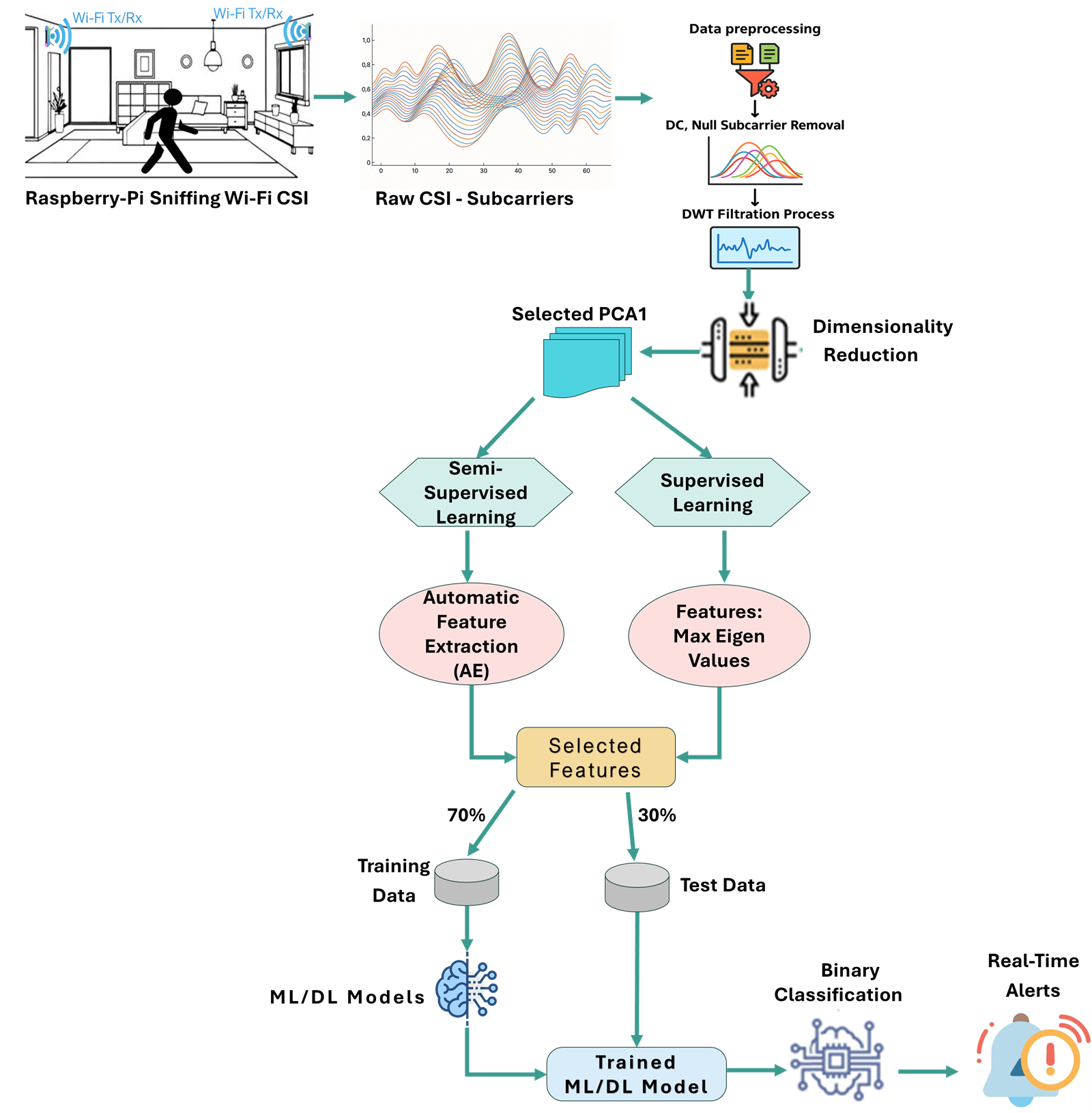
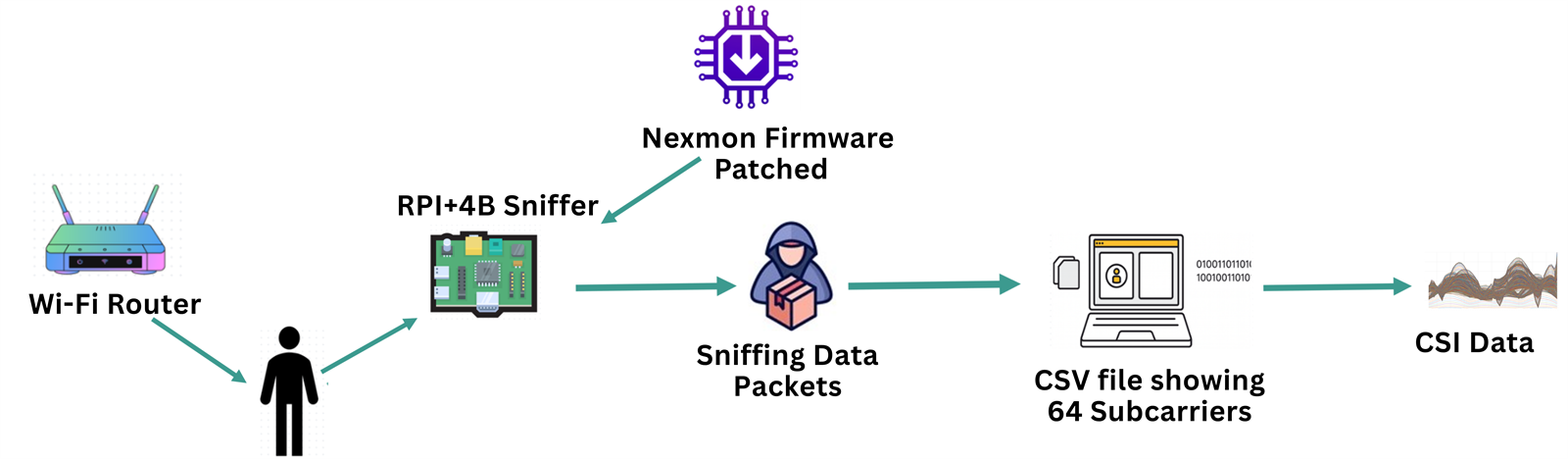
PiSense is a low-cost, real-time occupancy detection system that uses WiFi Channel State Information (CSI) captured passively on a Raspberry Pi with the Nexmon toolchain. CSI is cleaned with DC/null-subcarrier removal and Discrete Wavelet Transform (DWT) filtering, and features are extracted either automatically with an autoencoder (semi-supervised) or as maximum eigenvalues (supervised), before a trained ML/DL model decides in real time whether a room is occupied.
@article{zaman2026pisense,title={PiSense: a Raspberry Pi-based real-time occupancy detection system using CSI from commodity WiFi},author={Zaman, Qamar and Ahmad, Muhammad and Khan, Sagheer and Salman, Muhammad},journal={Computing},volume={108},number={11},pages={161},year={2026},month=oct,publisher={Springer},doi={10.1007/s00607-026-01751-9},}
Time-series WiFi Channel State Information (amplitude and phase across 64 subcarriers, 2.4 GHz / 20 MHz) collected passively with a Raspberry Pi 4 Model B and the Nexmon CSI toolchain in three indoor rooms of different sizes. Scenarios cover an empty room, one person (static and moving) and multiple people, labelled Occupied / Not Occupied. Includes raw .pcap captures, pre-processed .csv files, Python capture scripts, DWT denoising and Doppler-based motion features.
@misc{zaman2025csidataset,title={CSI Dataset for WiFi Based Human Detection},author={Zaman, Qamar and Ahmad, Muhammad and Salman, Muhammad and Khan, Sagheer},howpublished={IEEE DataPort},year={2025},month=jun,doi={10.21227/smn7-jb67},}
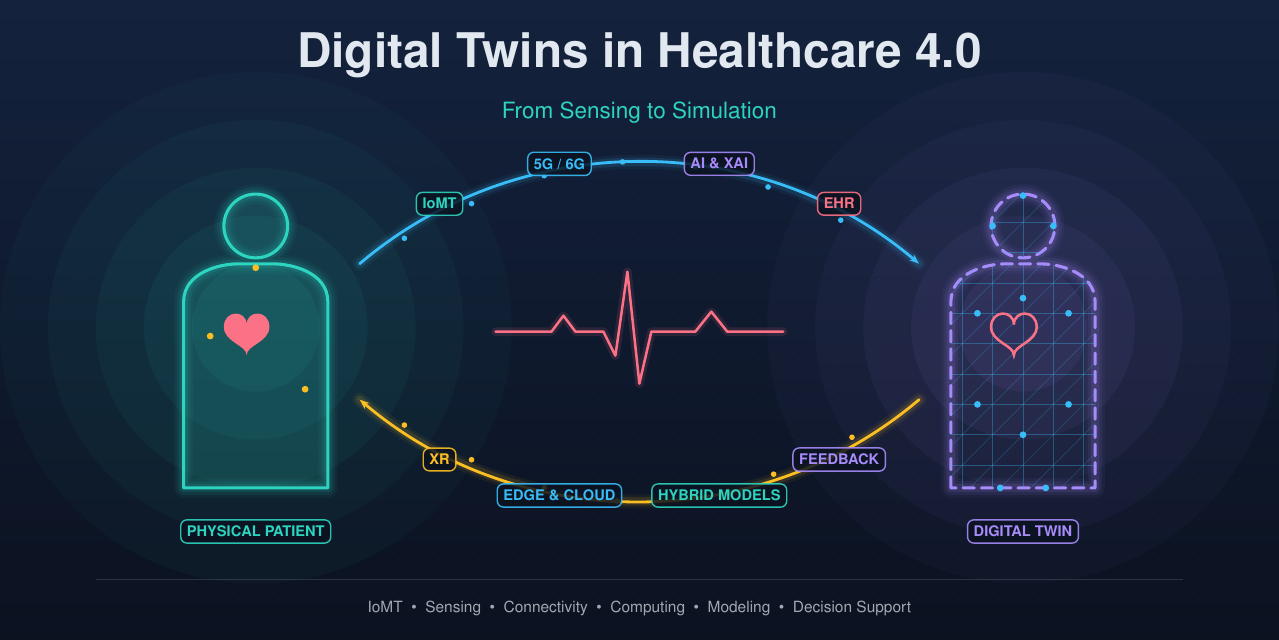 Digital Twins in Healthcare 4.0: A Review2026Submitted for publication